Is It Legal to Recreate a Viral Video With AI? What Creators Actually Need to Know in 2026
# Is It Legal to Recreate a Viral Video With AI? What Creators Actually Need to Know in 2026
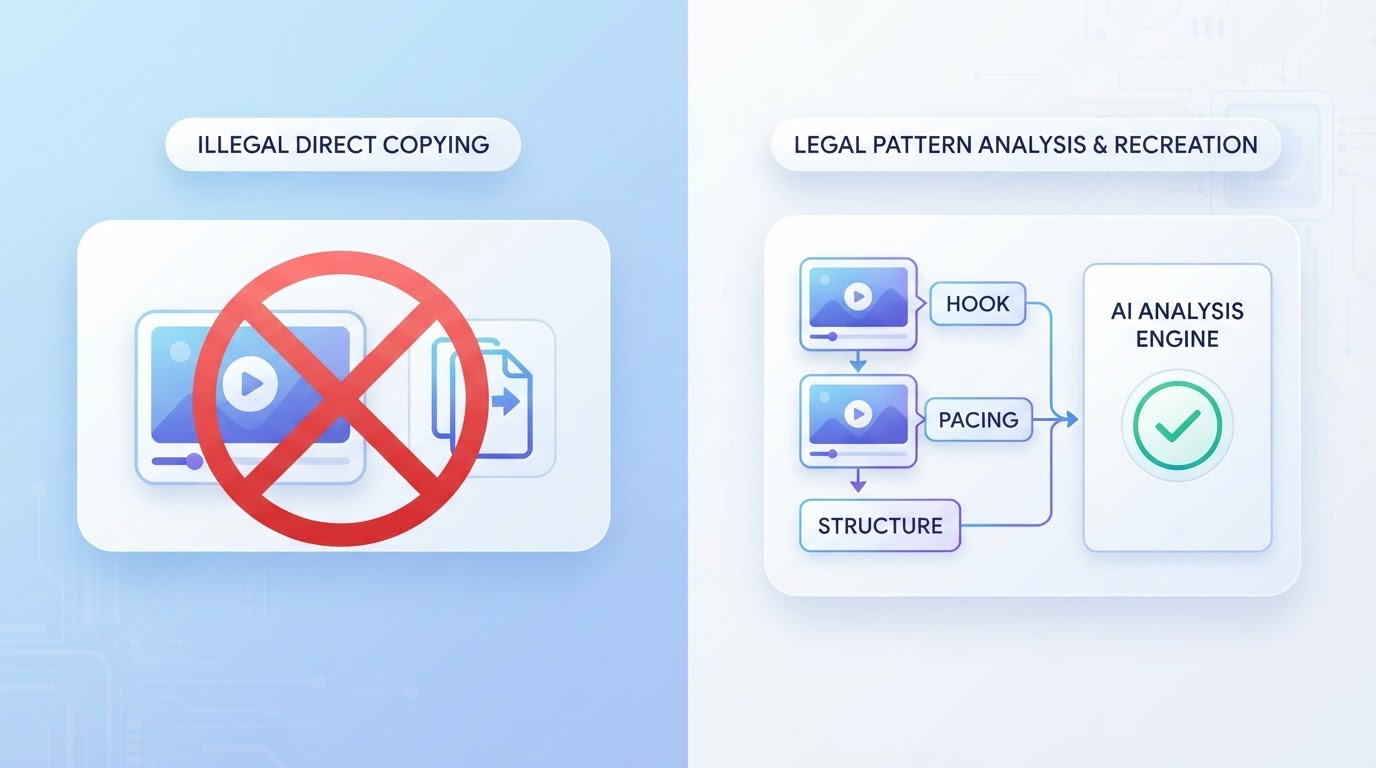
Short answer: recreating the *pattern* of a viral video — its hook, its pacing, its structure — is generally fine. Re-uploading or closely copying the actual *footage, dialogue, or audio* is where you cross into copyright territory. Most of the confusion creators run into comes from not knowing where that line actually sits, so here's the real version, not the "just be careful" hand-wave you usually get.
This isn't legal advice — it's a plain-English map of how copyright actually treats this stuff, so you can make an informed call before you hit publish.
## The Question Every AI-Recreation Creator Eventually Asks
You find a video that's clearly working. Great hook, tight pacing, a payoff that lands. You want to make something in that same style for your own niche — same structural beats, completely different footage, script, and subject. Is that legal, or are you one strike away from a takedown?
The honest answer is: it depends on what you're actually reusing. And that's not a dodge — copyright law draws a specific, well-established line here, and once you know where it is, most of the anxiety around AI video recreation tools goes away.
## What Copyright Actually Protects (and What It Doesn't)
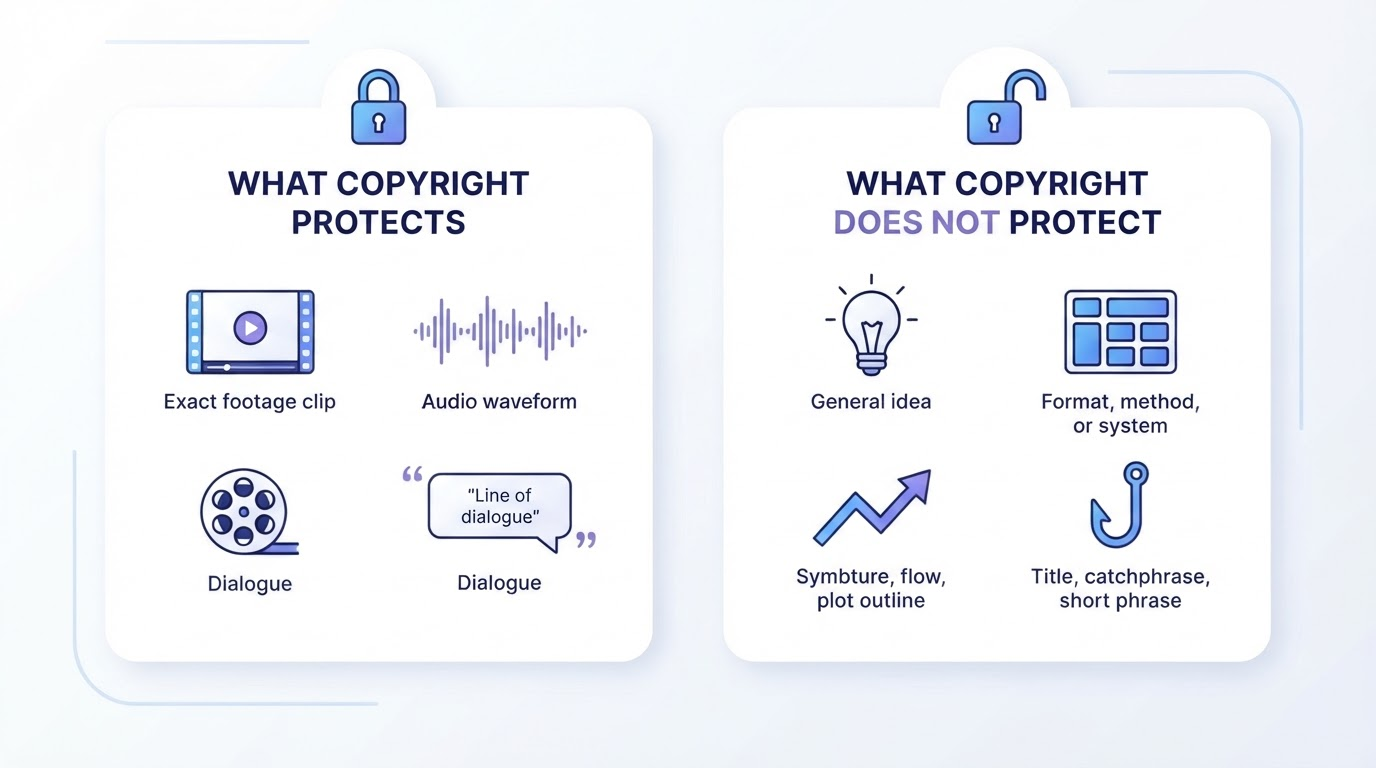
Copyright protects **expression** — the specific words, footage, music, and edit choices someone actually created. It does not protect **ideas, formats, or styles**. That distinction, sometimes called the idea-expression dichotomy, is the foundation of basically every fair-recreation case that's ever been decided.
Filming your own version of a "day in the life" format, a POV cooking hook, or a rapid-fire listicle structure isn't infringement, because none of those are protectable expression — they're formats, and formats belong to everyone. Someone recreating the *style* of a well-known filmmaker's shots, for example, isn't automatically infringing that filmmaker's copyright, because style itself isn't ownable.
| Protected by copyright | Not protected by copyright |
|---|---|
| The exact footage/clip itself | The video's format or structure |
| Original dialogue or script wording | A hook style or opening pattern |
| Licensed or original music/audio | Pacing, editing rhythm, cut frequency |
| A distinctive, specific visual sequence | A general topic, trend, or idea |
> Copyright protection typically extends to the specific expression of ideas, not to the ideas, formats, or styles themselves — which is why recreating a video's structure is treated very differently under the law than copying its footage.
## Where the Line Actually Gets Crossed
The legal test that matters here is **substantial similarity** — whether your version reuses the *protected elements* of the original closely enough that it counts as the same expression, not just the same idea. A few things push you toward real risk:
- Using the actual source footage, even short clips, without a license or a clear fair-use basis
- Reusing someone's exact scripted dialogue or narration, word for word
- Using the original's copyrighted music or audio track
- Recreating a *specific, distinctive* visual sequence shot-for-shot (not "a hook," but *that exact hook*, framed identically)
And a few things generally keep you safe:
- Writing your own script and generating your own AI narration
- Generating or filming entirely new visuals, even if the pacing/structure mirrors the original
- Applying the same *category* of hook (contrarian claim, pattern interrupt, before/after) with your own content
- Covering a different topic entirely, using only the structural skeleton
Determining infringement is genuinely fact-specific — courts look at how much of the *protected* material was reused and whether what you made stands on its own. But the pattern above holds consistently: structure and format sit on the safe side of the line, footage and fixed expression sit on the risky side.
## Fair Use and Transformative Value — What Actually Helps Your Case
Even in the rare case where a recreation gets close to protected material — say, you're reacting to or directly referencing a specific clip — fair use can still apply if your version is **transformative**: it adds new expression, meaning, or commentary rather than just repackaging the original.
A few factors that push toward fair use:
- You added your own analysis, commentary, opinion, or new context, not just a re-post
- Your version serves a different purpose than the original (education, commentary, parody vs. pure entertainment reuse)
- You used only as much of the original as needed to make your point, not the whole thing
A few factors that work against you:
- Your version is a substitute for the original — someone could watch yours instead of the source and get the same experience
- You're using it commercially in a way that competes directly with the original creator's ability to profit
- You added minimal or no new expression on top of the source material
None of this is a strict formula — fair use is decided case by case — but "I added something real" is a meaningfully stronger position than "I copied it and hoped nobody noticed."
## A Practical Framework: The "Pattern, Not Copy" Test
Before you publish an AI-recreated video, run it through five quick questions:
1. **Am I reusing the actual footage or audio, or just the structural pattern?** Footage = risk. Pattern = generally fine.
2. **Side by side, would someone call this "the same video" or "the same idea, different execution"?** You want the second answer.
3. **Did I write my own script, generate my own voice, and use my own (or newly generated) visuals?** If yes, you're on solid ground.
4. **Am I directly referencing or reacting to one specific video?** If so, make sure you're adding real commentary, not just repackaging it.
5. **Would this recreation directly substitute for the original in the market?** If someone could watch yours instead of theirs and lose nothing, that's a red flag.
If you're spending time manually [reverse-engineering viral videos](https://clipnovia.io/blog/how-to-reverse-engineer-viral-videos) to find the pattern in the first place, this framework is worth keeping next to your notes — it's the difference between "inspired by" and "infringing," and it holds up whether you're extracting the pattern by hand or with a tool.
## How This Plays Out With AI Recreation Tools Specifically
This is where the practical answer gets clearer, not murkier. Tools that just download and re-encode someone else's clip are doing the risky thing — they're distributing the original's actual footage, which is exactly what substantial-similarity analysis targets.
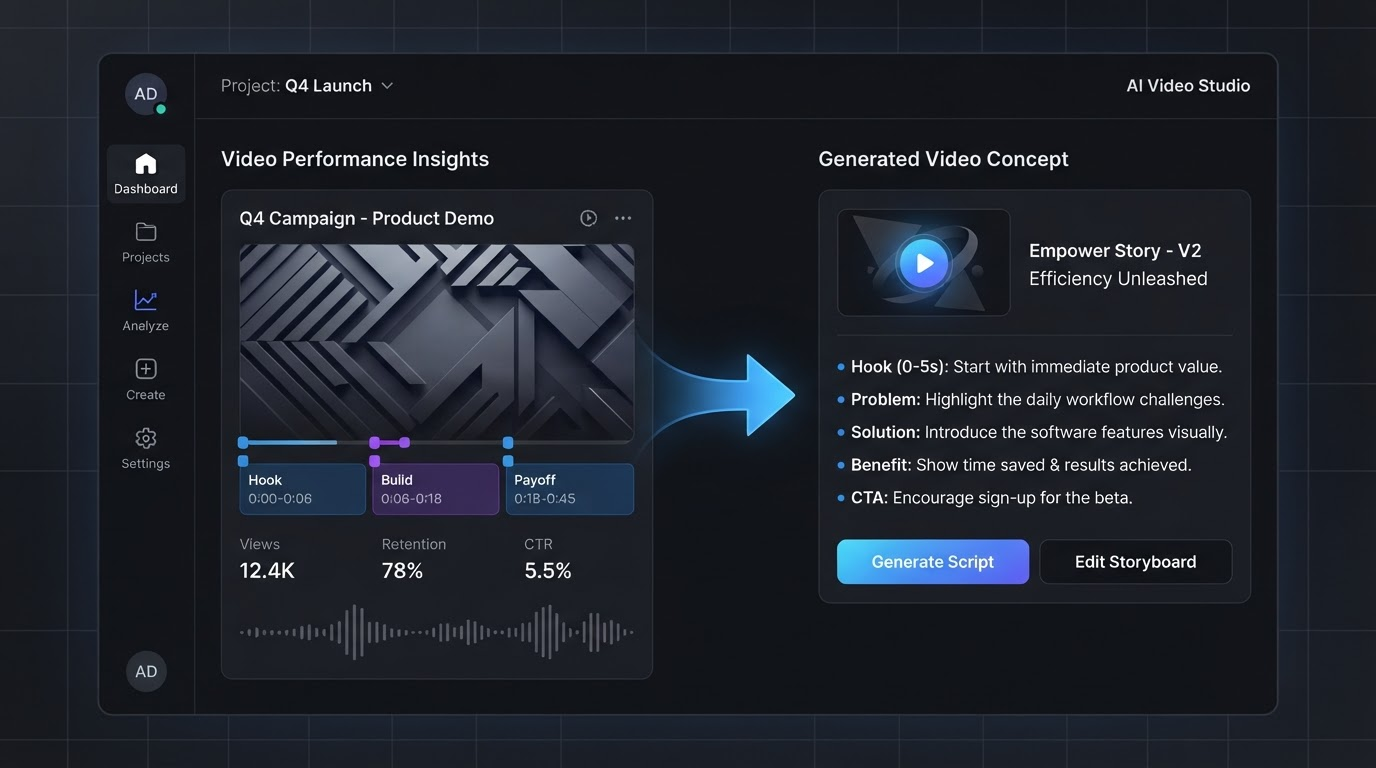
Tools that *analyze* a reference video — pulling out its [hook formulas](https://clipnovia.io/blog/viral-hook-formulas-for-short-form-video), pacing, and structural beats — and then generate a genuinely new video from that analysis are doing something structurally different. The output shares a pattern with the source, not its protected expression. That's the same legal distinction that's protected style-recreation and format-following content for as long as short-form video has existed; AI just makes the analysis step faster and more consistent than eyeballing a video ten times and taking notes.
That output quality gap is worth taking seriously too — a recreation that leans on the real pattern but still comes out with warped hands or a flickering background reads as low-effort even when it's legally fine. See [why AI-generated videos look fake](https://clipnovia.io/blog/why-ai-generated-videos-look-fake) for the specific, fixable causes.
It's worth keeping platform rules separate from copyright law here, too — they're two different risk categories. A platform's terms of service can restrict things copyright law wouldn't (like posting near-duplicate reaction content), and copyright law can restrict things a platform's ToS doesn't mention at all. Being clear of one doesn't automatically clear you of the other, so it's worth a quick skim of whichever platform you're posting to if you're recreating something very close to a specific trend.
This is the actual workflow worth using: paste a reference video into ClipNovia to analyze its hook, pacing, and structure, then generate an original video concept — your own script, your own voice, your own visuals — based on the patterns that made it work, not a copy of the footage itself.
## YouTube's October 2026 Shorts Policy Adds a Separate Risk: Algorithmic Reach, Not Just Copyright
Everything above is about copyright law. As of October 2026, there's now a second, distinct risk category worth knowing about if you recreate viral videos for Shorts specifically: YouTube's own recommendation system.
On October 1, 2026, YouTube published an update to its Shorts policy stating it is "updating our recommendation systems to further prioritize original content and reduce the reach of content re-uploaded from other creators without adding anything of your own." The same post goes further on channel-level enforcement: "Channels identified as primarily aggregating or re-uploading other creators' videos without significant changes will likely see less distribution within the Shorts feed." (Source: YouTube's official Shorts blog post, corroborated independently by 9to5Google, PPC Land, and several other outlets within 48 hours.)
A few things worth being precise about, since YouTube hasn't spelled all of it out yet:
- **This is a reach and recommendation change, not a monetization change.** It's separate from the existing reused-content rules that already govern Partner Program eligibility and Creator Pool payouts, both of which are untouched by this update.
- **YouTube explicitly said minor technical edits, template-based bulk changes, and voice-over narration layered on someone else's clip do not count as "original."** That line is attributed to YouTube Creator Liaison Rene Ritchie in the same rollout.
- **No start date or reach re-evaluation timeline was given.** As of this writing, YouTube hasn't said when enforcement begins in practice or how a channel would know its reach was reduced.
- **YouTube did not address AI recreation tools directly.** The policy text names "re-uploaded," "aggregating," and "template-based" content, not tools that analyze a reference video's structure and generate new footage, script, and voice from it. Whether a structurally original AI recreation clears YouTube's own bar for "adding something of your own" has not been confirmed by YouTube, and no outlet covering this story has reported an official answer either.
That last point matters for the "pattern, not copy" framework above. This platform policy doesn't hand AI recreation tools a free pass, and nothing here is a guarantee. But it draws YouTube's own line in nearly the same place copyright law already does: straight re-uploads and templated edits lose reach, while genuinely new footage, script, and voice built on a structural pattern is the thing YouTube says it isn't targeting. If you're already running the five-question test earlier in this article, you're already on the safer side of this newer, separate risk too. Treat it as one more reason the actual expression, your own script, your own voice, your own visuals, needs to be real rather than a box-ticking formality.
*Checked against YouTube's own Shorts policy post and independent reporting as of 2026-10-14. YouTube has not published a specific enforcement start date, so this is worth a second look if you're relying on it for a time-sensitive decision.*
## When to Actually Get a Lawyer Involved
Most creator-scale recreation — same hook style, new topic, your own script and visuals — never needs legal review. A few situations genuinely do:
- You're running a paid brand or advertiser campaign built directly around someone else's specific viral video
- You received a copyright claim, strike, or cease-and-desist and aren't sure how to respond
- You're using someone's actual likeness, voice, or identity (a different legal category — right of publicity — that copyright doesn't cover)
- You're licensing or reselling recreated content at scale as part of a commercial product
Outside of those, the "pattern, not copy" distinction above will keep the overwhelming majority of AI-recreated short-form content well clear of real infringement risk. But this article is general information, not a substitute for advice from an actual attorney about your specific situation — if real money or a specific legal threat is involved, that's the point to stop guessing and ask one.
## The Bottom Line
Recreating a viral video's format with AI is not the same thing as copying it, and copyright law has drawn that line clearly for decades — AI recreation tools didn't create this legal question, they just made acting on the safe side of it faster. Keep your footage, script, and voice your own, use the source only as a structural reference, and you're operating in exactly the space creators have always been free to work in. The moment you start reusing someone's actual clip, dialogue, or track, you've left that space — and no AI tool changes that part of the equation.
If your views tend to spike on a recreation and then [crash back down afterward](https://clipnovia.io/blog/why-do-views-drop-after-a-viral-video), that's usually a distribution problem, not a legal one — but it's worth ruling out the legal question first, since it's the one nobody wants to discover after the fact.
Legal risk isn't the only thing that determines whether a recreation performs, either. See [why your AI-recreated viral video isn't performing like the original](/blog/why-ai-recreated-viral-video-not-performing) for the structural difference between a safe, legal recreation and one that actually repeats the original's watch-time pattern.