Nano Banana 2.1 vs. Nano Banana 2: We Ran the Same Prompt Through Both (And It's Less Than Half the Price)
# Nano Banana 2.1 vs. Nano Banana 2: We Ran the Same Prompt Through Both (And It's Less Than Half the Price)

Google shipped Nano Banana 2.1 on October 6, 2026, as a generally available update to Nano Banana 2 (internally, Gemini 3.1 Flash Image). It's not a separate product you have to go find — if you're generating reference images, storyboard frames, or thumbnail stills inside ClipNovia right now, there's a real chance you're already running it. We checked ClipNovia's own model catalog while writing this, confirmed it's live in the pipeline, and then ran the exact same two prompts through both the old model and the new one so you can see the difference instead of taking a vendor's word for it.
## What actually changed, according to Google
Per Google's own release documentation (not a reseller's summary), Nano Banana 2.1 is described as an update to Nano Banana 2 that improves:
- Overall visual quality and prompt adherence
- Multi-turn character consistency across a conversation
- Text rendering inside generated images
- Tiling artifacts that showed up on unusually wide or panoramic images at 2K and 4K
It still supports 1K, 2K, and 4K output (1K is the default), handles up to 14 reference images in one request, holds consistency for up to 4 characters and fidelity for up to 10 objects, and now accepts text, image, video, and PDF as input with web and image-search grounding. Google's deprecation notice lists the prior endpoint, `gemini-3.1-flash-image`, as scheduled to shut down no earlier than October 29, 2026 — so if you or a tool you use calls that model directly by name, that date is worth a calendar reminder.
None of that is independently benchmarked; it's what Google's documentation claims. We didn't have a reason to doubt the specific capability list, but "better text rendering" and "better character consistency" are exactly the kind of claims that are easy to repeat and hard to check. So we checked the part that matters most for a short-form video pipeline: does it actually look different, and does it actually cost less.
## What it costs inside ClipNovia, measured today
This is the one number in this article that isn't an estimate from a press release. Pulled directly from ClipNovia's own model list on 2026-10-13:
| Model | 2K image cost |
|---|---|
| Nano Banana 2 | 22 credits |
| Nano Banana 2.1 | 10 credits |
That's a 55% drop per image at the same resolution tier, which lines up with Google's own framing of 2.1 as "the successor to Nano Banana 2 at about half its price." If you're generating a batch of reference stills or thumbnail variations for a channel, that's not a rounding error — it roughly doubles how many images your existing credit balance covers.
## The test: same prompt, two models, no cherry-picking
We ran two prompts, word-for-word identical, through `nano-banana-2` and `nano-banana-2-1` inside ClipNovia on the same day, same resolution (2K), same aspect ratio per pair. Both outputs are below, unedited. We're not going to tell you one is obviously better — judge the actual pixels yourself, since that's the point of publishing both. What we can tell you honestly is the price difference above and the documented changes Google lists; a single side-by-side pair isn't a statistically valid quality benchmark, and we're not presenting it as one.
**Test 1 — a reusable character reference portrait.** This is the asset type a faceless-style or stylized-persona channel actually needs over and over: a clean, consistent reference image a video-generation step can pull a character from later. Prompt used for both: *"Photorealistic reference portrait of a friendly female lifestyle creator in her late 20s, warm natural lighting, plain neutral studio background, medium close-up shot, confident warm smile, looking directly at camera, high detail skin texture, used as a consistent character reference image for short-form video production."*

*Nano Banana 2 — 22 credits.*

*Nano Banana 2.1 — 10 credits.*
**Test 2 — a bold-text thumbnail mockup.** Text rendering is the specific capability Google called out as improved, so we tested it on the kind of asset where bad text rendering is most obvious: a high-contrast Shorts thumbnail with large overlay text. Prompt used for both: *"A bold, high-contrast YouTube Shorts thumbnail design: large white sans-serif text reading 'NANO BANANA 2.1' centered over a vibrant orange gradient background, a cartoon banana character wearing sunglasses giving a thumbs up in the corner, clickbait tech-review thumbnail style."*
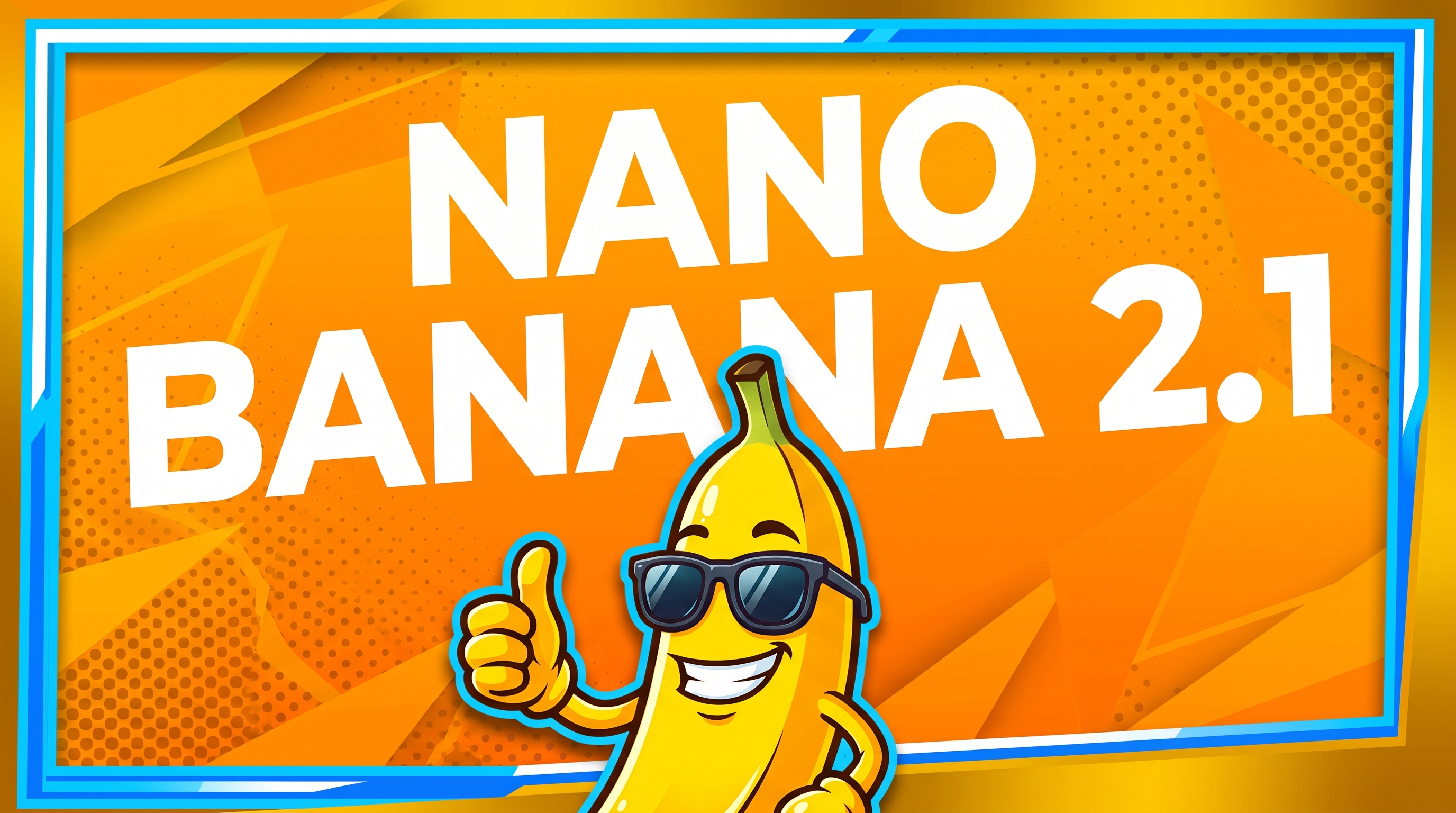
*Nano Banana 2 — 22 credits.*
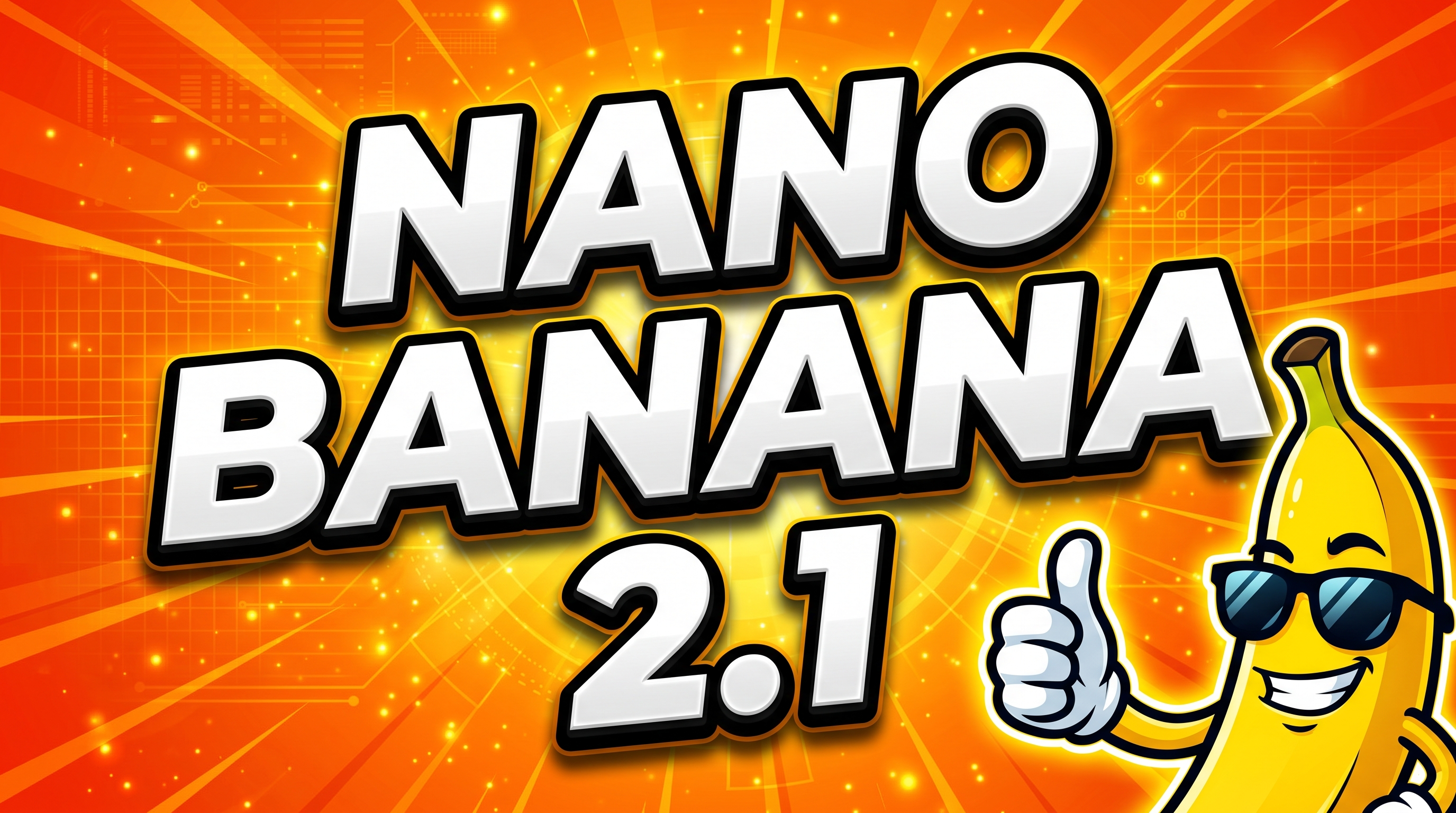
*Nano Banana 2.1 — 10 credits.*
If you want to run your own version of this test before trusting ours, that's the right instinct — model behavior drifts, and a single run on a single day is a data point, not a certification. Use your own reference prompts, generate both, and compare them against what you actually need the image for.
## Why this is rising in search right now
This isn't a slow-burn story. Keyword-demand data pulled on 2026-10-13 shows "nano banana 2.1" at an estimated 464,761 monthly searches globally (about 49,500/month in the US alone), with moderate-low competition (28.9/100) — not a crowded term yet. The more telling number is the daily search-interest trend: it sat near zero through early October, then jumped from roughly 150 views-per-hour on October 5 to over 13,600 on October 6 — the day Google shipped it — and has stayed in the five-figure range most days since. That's demand that tracks a specific, dated launch event, not a slow organic climb.
One comparison-intent long-tail query is already showing real, measurable volume on the same dataset, pulled 2026-10-13: "nano banana 2.1 vs gpt image 2.5" at around 16,400 searches/month — people comparing the new model against alternatives entirely outside the Nano Banana family. The narrower question this article actually answers, 2.1 against its own predecessor, doesn't yet show measurable standalone search volume on the same pull (under 750/month): the update is six days old, and "which exact version should I use" is still the kind of question people ask inside the tool itself before they type it into a search bar. That gap is exactly why a first-party, product-specific answer is worth publishing now, ahead of the query volume.
## What's already out there, and what isn't
Search today turns up two kinds of existing coverage: AI-model benchmark arenas that score Nano Banana 2.1 against competing models on generic leaderboards, and general character-consistency documentation aimed at anyone using the model through any platform. Neither angle is written for someone who already has a ClipNovia project open and just wants to know whether switching models changes their actual output and their actual bill. That's the gap this piece is filling — a first-party answer using the product's own pricing and a same-input test, not a repackaged leaderboard score.
## Should you do anything differently?
If you're generating reference images, storyboard stills, or thumbnail mockups inside ClipNovia, the model picker already defaults you toward the current generation — you don't need to hunt for a toggle. The practical takeaway is simpler than a feature list: at less than half the credit cost of Nano Banana 2 for the same 2K output, there's very little reason to keep manually selecting the older model for routine reference-image work. Nano Banana Pro remains the better pick specifically when you need the sharpest possible text rendering for a hero thumbnail — that's a different job than generating a batch of character references, and the Pro tier is priced accordingly.
## FAQ
**What is Nano Banana 2.1?** It's Google's October 6, 2026 update to its Nano Banana 2 (Gemini 3.1 Flash Image) model — an image generation and conversational-editing model, not a new standalone product name change.
**Does ClipNovia use Nano Banana 2.1?** Yes, as of this article's publish date, it's one of the image models listed directly in ClipNovia's own model catalog, priced at roughly half of Nano Banana 2 for the same resolution.
**Is Nano Banana 2.1 free?** Google's own API documentation states there is no free API tier, with per-image pricing that scales by resolution. Inside ClipNovia, it's billed from your existing credit balance like any other image generation, just at a lower rate than its predecessor.
**Should I still use Nano Banana Pro instead?** If sharp text rendering on a single hero image is the priority, Pro is still the stronger, pricier option. For routine reference images and batch thumbnail variations, 2.1's price makes it the easier default.
**When should this be rechecked?** Google's prior endpoint (`gemini-3.1-flash-image`) is scheduled to stop working no earlier than October 29, 2026, and ClipNovia's own model lineup can change again — treat the pricing and model-availability claims here as current as of October 13, 2026, and verify both directly before relying on them after the end of October.
If you're picking between AI video tools more broadly and not just the image step, [our guide to choosing an AI avatar tool](https://clipnovia.io/blog/ai-avatar-tool-for-faceless-channel) and [the job-based way to pick an AI Shorts generator](https://clipnovia.io/blog/ai-shorts-generator-guide) cover the adjacent decisions. If you're wondering what a video-to-video model can and can't do for you, [we broke that down separately](https://clipnovia.io/blog/video-to-video-ai-explained). And if you want to run this exact kind of same-prompt test yourself on your next project, [ClipNovia's image generation](https://clipnovia.io/features) is where that reference-image step already lives.
Sources: [Google rolls out Nano Banana 2.1 image model](https://letsdatascience.com/news/google-rolls-out-nano-banana-21-image-model-c6ac3b89) (letsdatascience.com, 2026-10-06) · [Gemini Nano Banana 2.1 API pricing and migration](https://smartscope.blog/en/blog/gemini-nano-banana-21-api-pricing-migration-2026/) (smartscope.blog, 2026-10-06) · demand and search-interest figures from vidIQ keyword research, pulled 2026-10-13 · ClipNovia model catalog and credit pricing, pulled 2026-10-13.